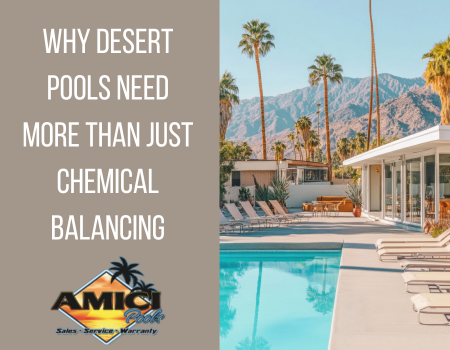
 Desert pool care is often reduced to one idea; Keep the chemicals balanced and everything else will fall into place. While water chemistry is essential, desert pools face challenges that go far beyond chemical levels. Heat, dust, wind, and heavy sun exposure create conditions that demand a more complete approach to maintenance.
Relying only on chemical balancing overlooks mechanical wear, physical cleaning, and circulation strategy, all of which play a critical role in keeping desert pools healthy and long lasting.
Why Desert Pools Need More Than Just Chemical Balancing
Mechanical wear happens faster in the desert
Desert heat is hard on pool equipment; pumps, motors, seals, and valves operate under constant thermal stress during long swim seasons. High temperatures cause materials to expand, lubricants to break down faster, and electrical components to work less efficiently.
When equipment runs nearly year round, wear accelerates; pumps may lose efficiency, seals may dry out and crack, and bearings may fail sooner than expected. These issues are not solved by perfect water chemistry, in fact, when circulation is compromised by mechanical wear, chemical balance becomes harder to maintain.
Ignoring early signs of mechanical stress often leads to reduced water movement, uneven sanitizer distribution, and increased strain on other components. Over time, this creates a cycle where chemicals are added more frequently to compensate for poor circulation, masking the underlying problem.
Why brushing matters more than most people think
In desert environments, dust and fine debris are constant. Wind carries sand, soil, and organic particles into pools daily. Even when water looks clear, these particles settle on walls, steps, and floors, creating ideal surfaces for algae and bacteria to cling to.
Chemical sanitizers work best in moving water, because when debris sticks to surfaces, it forms a protective layer that shields microorganisms from chlorine, and this is why desert pools often develop algae despite balanced chemistry.
Regular brushing physically disrupts this buildup, it removes biofilm, loosens dust, and exposes surfaces so sanitizers can do their job. Without brushing, chemicals are forced to work harder and are often blamed when problems arise.
Brushing also helps prevent staining and scale buildup. In areas where there is hard water, there is the tendency for minerals to settle and harden on surfaces. Physical agitation slows this process and preserves the pool finish.
Circulation strategy is just as important as chemistry
Circulation determines how effectively chemicals are distributed and how well debris is removed. In desert pools, circulation needs are often higher due to increased contamination from dust and heat.
Running the pump longer during hot and windy periods helps move contaminants toward the filter before they settle. Strategic return jet positioning improves water movement in areas that are prone to stagnation, such as corners and steps.
Poor circulation creates dead zones where sanitizer levels drop and debris accumulates. These zones become breeding grounds for algae, regardless of how well the overall water chemistry is balanced.
Variable speed pumps offer an advantage in desert conditions. Running at lower speeds for longer periods improves filtration efficiency while reducing energy costs. This steady movement supports better water quality without excessive wear.
Filters can only do so much
Filters are often expected to solve all water quality issues, but they have limitations. Fine desert dust can pass through filters or clog them quickly, reducing flow and efficiency. Without regular cleaning or backwashing, filters become bottlenecks in the system.
When flow drops, heaters, chlorinators, and other equipment suffer. Chemical readings may appear acceptable, but the water is not being circulated or cleaned effectively.
Maintaining filter health is part of a broader mechanical strategy. It supports circulation, reduces equipment strain, and improves overall water clarity.
Chemicals are part of a system, not a solution
Chemical balancing is a tool, not a cure all. In desert pools, chemicals must work alongside physical cleaning and mechanical reliability. When brushing is skipped or circulation is poor, chemicals are asked to compensate for issues they cannot fully address.
This often leads to overuse of chlorine or algaecides, which increases costs and can create new problems such as irritation or surface damage.
A balanced approach recognizes that clean water is the result of multiple systems working together. Mechanical components move the water, brushing cleans the surfaces, and chemicals sanitize what remains.
A more complete approach to desert pool care
Desert pools operate in one of the most demanding environments possible. Heat, dust, and long swim seasons place constant pressure on both water and equipment.
Maintaining these pools requires more than test strips and chemical adjustments. It requires attention to mechanical wear, consistent brushing, and thoughtful circulation strategy.
When these elements work together, pools stay cleaner, equipment lasts longer, and maintenance becomes more predictable. Chemical balancing remains important, but in the desert, it is only one piece of a much larger picture.