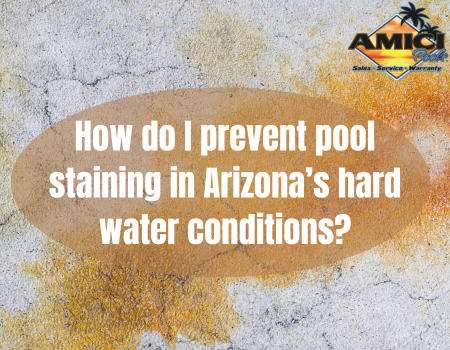
 Pool staining in Arizona is a different problem than pool staining in most other markets because the source is different. In moderate climates, pool staining comes primarily from organic material. In Arizona, the dominant staining mechanism is mineral precipitation from fill water that’s some of the hardest in the country. The calcium and magnesium that come out of the tap don’t disappear into the pool water. They accumulate, concentrate as the water evaporates, and eventually precipitate onto every surface the water contacts.
Understanding that the staining is mineral-driven rather than organic-driven changes what prevents it.
What Hard Water Does to Pool Staining
Every gallon of water that evaporates from an Arizona pool leaves its dissolved mineral content behind. The fill water added to replace it brings more minerals. The concentration builds through the season in a way that accelerates as temperatures peak and evaporation rates increase.
Calcium scale appears first at the waterline, where evaporation is most active, as a white or grey film that builds into a rough, crusty deposit bonding to tile, plaster, and pebble surfaces over time. Scale addressed early, when it’s still a thin film, responds to brushing and chemical treatment. Scale allowed to build for a full season requires acid washing or mechanical removal, both more invasive and more expensive than the prevention that would have kept it from forming.
The chemistry governing whether calcium stays in solution or precipitates onto surfaces is captured in the Langelier Saturation Index, which balances pH, calcium hardness, alkalinity, temperature, and total dissolved solids. Arizona pool water that isn’t actively managed toward a balanced LSI is almost always on the scaling side.
Chemical Balance
pH is the most important variable in preventing mineral precipitation and the one requiring the most frequent attention in Arizona summers. Calcium carbonate precipitation accelerates as pH rises above 7.6, and in warm water, pH drifts upward faster than in cool water. A pool test at 7.4 on Monday may be at 7.8 by Thursday, and the precipitation happening during those three days is building the scale deposit that shows up at the waterline weeks later.
Alkalinity determines how much pH drifts between adjustments. Total alkalinity in the correct range, typically 80 to 120 ppm, buffers pH against rapid movement. Getting alkalinity into the right range makes pH management more predictable and reduces the frequency of acid additions needed to keep pH below the precipitation threshold.
Calcium hardness in Arizona pool water requires management rather than addition. Filling water in most Arizona markets brings enough calcium that the pool reaches and exceeds the recommended range of 200 to 400 ppm through normal top-off over a season. Above 600 ppm, the water is precipitating calcium onto surfaces regardless of how well pH and alkalinity are managed. Partial drain and refill is the intervention that addresses elevated calcium hardness when chemical management alone can’t control it. This is a more frequent maintenance activity in Arizona than in soft water markets.
Brushing
Brushing is the mechanical prevention step that chemical balance supports, but can’t replace. Calcium scale forms through a nucleation process—mineral crystals begin forming on the surface texture and grow from there. Brushing disrupts this early stage by physically removing initial mineral deposits before they bond to the surface.
The waterline tile is the highest-priority brushing target in Arizona pools because it’s where evaporation is most active and where scale initiates most aggressively. Brushing the waterline specifically several times per week during peak summer, rather than on a standard weekly schedule, keeps the surface inhospitable to the mineral nucleation that turns into visible scale.
Sequestrants and Scale Inhibitors
Scale inhibitor products interfere with mineral precipitation at the chemical level by binding to calcium and magnesium ions and keeping them in solution rather than allowing them to precipitate onto surfaces. In Arizona’s hard water environment, these products are maintenance tools rather than occasional treatments. Regular sequestrant addition through the season, particularly during peak evaporation months when mineral concentration is building fastest, reduces the precipitation load on surfaces regardless of how well pH and alkalinity are managed.
The sequestrant products that work best in Arizona conditions are specifically formulated for calcium carbonate scale rather than generic pool stain treatments. The active chemistry addressing calcium carbonate is different from what addresses metal staining or organic staining. Matching the product to the specific staining mechanism is the difference between prevention that works and prevention that’s going through the motions.
The Water Quality Association’s hard water resources cover how calcium and magnesium concentrations vary by region, what hardness levels are considered extreme, and how mineral content affects surfaces and equipment — useful context for Arizona pool owners trying to understand why their fill water creates staining problems that general pool maintenance guidance doesn’t fully address.